Glass colorFlint (clear) standard; amber on request
Neck finish28–31.5 mm CT finish
Closure optionsCT cap with LDPE orifice reducer or pour spout; tamper band optional
Liner / sealPE or pressure-sensitive liner; reducer fitted in the neck
DecorationLabels or screen printing on three flat panels, sleeves
PackingPartitioned cartons; alternating layout for dense packing
Product Knowledge
About the Triangular Salad Dressing Bottles
Background, typical uses and selection points for this product. We can send model drawings, technical data and samples to support your evaluation.
Overview
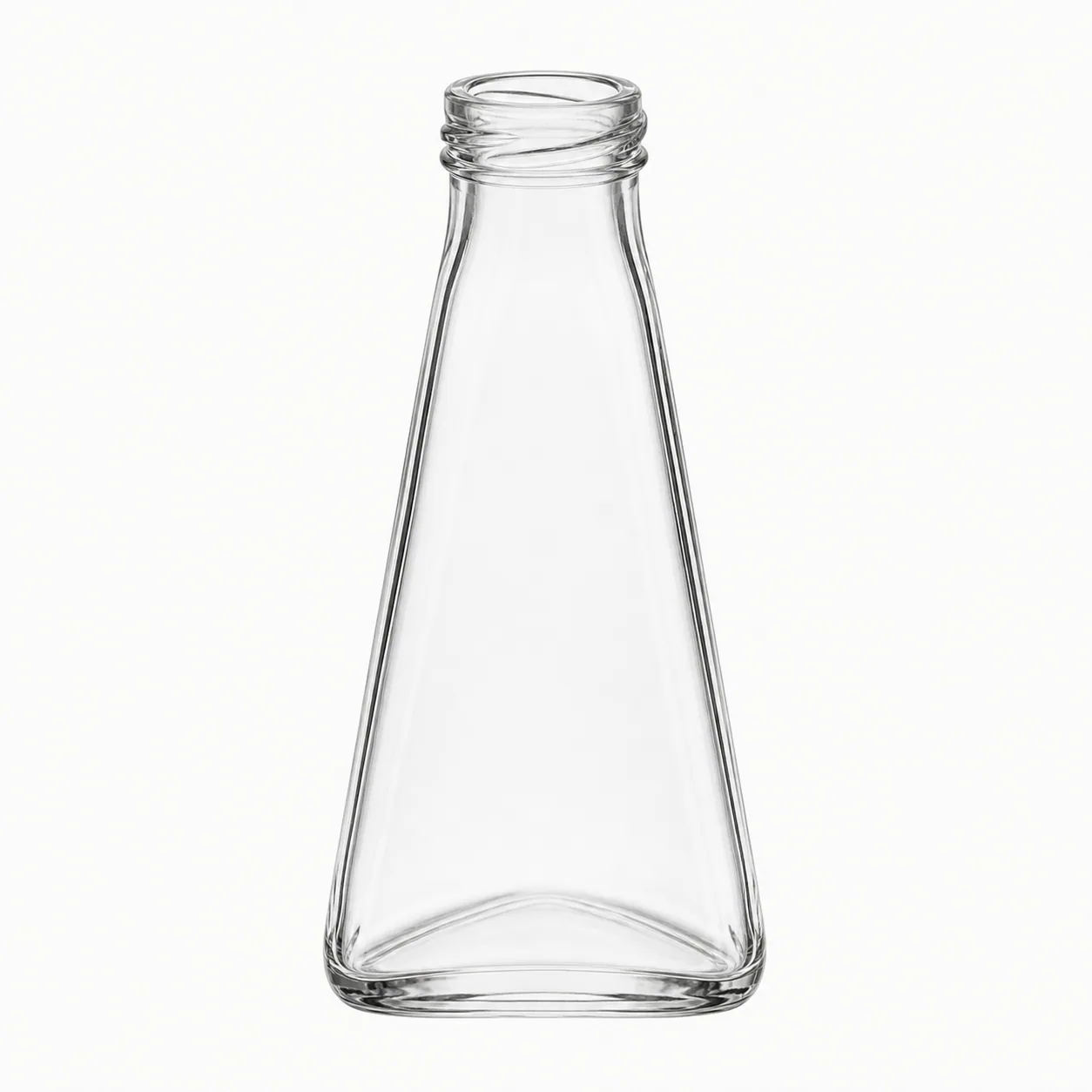
The triangular bottle is a deliberate point-of-difference shape. On a shelf of round and square bottles, three flat faces and crisp vertical edges catch the eye, and the tapered profile gives the bottle a confident, architectural look.
The geometry is practical too. The edges give a secure grip, and three separate panels let a designer split brand, story and ingredients across the faces instead of crowding them onto one label.
Applications & Industries
Salad dressings and vinaigrettes, finishing and infused oils, marinades, drizzle sauces, specialty vinegars and cocktail syrups. The shape is popular for premium and gift ranges, often sold as duos or trios that look striking grouped together.
With its narrow neck and reducer, it is a dosing bottle for thin, pourable products rather than a container for thick sauces. Smaller sizes also work well as sample and tasting bottles for markets and hospitality.
Design & Construction
Three flat panels meet at rounded vertical edges; the corner radii add strength and avoid a sharp, chip-prone edge. The body tapers toward the shoulder, and the CT neck takes an LDPE orifice reducer sized to the product’s viscosity for a controlled, drip-free pour.
As with any faceted bottle, keeping the glass even between the corners and the center of each panel is the main forming concern.
Filling, Sealing & Use
Many dressings are emulsions that separate, so the bottle is made to be shaken. Leave enough headspace for that, and fit the reducer and cap so nothing leaks when the bottle is inverted. High-acid vinaigrettes suit glass well; check that the cap liner is compatible with vinegar.
If you hot-fill an acidified dressing, ramp temperatures gently — panel centers and corners are the areas most sensitive to thermal and mechanical stress.
Manufacturing & Customization
Blow-and-blow or narrow-neck press-and-blow forming produces the body and a precise neck bore for the reducer, with the triangular molds defining the section and corner radii. Wall thickness across panels and corners is gauged, along with bore checks so the reducer snaps in and holds.
We can screen-print each panel, supply matched caps and reducers, and pack duo or trio gift sets. Send us your product viscosity and we’ll recommend the reducer aperture.
Customization
Build the Complete Package
We specify the container, closure, decoration and transit packing as one package, so every part fits and arrives ready for your filling line.
Dimensions & Form
Choose from standard sizes or request a custom capacity. We supply drawings with tolerances, label panel dimensions and nominal and brimful capacity.
Interfaces & Components
We match caps, liners, pumps, droppers and stoppers to the neck finish and check the seal against your contents and filling process.
Material & Finish
Flint, amber and colored glass, with frosting, spray coating, screen printing, hot stamping or labels. Material documentation is available on request.
Protective Packing
Partitioned cartons, layer pads or bulk pallets, with shipping marks and pallet patterns planned for your route and warehouse.
Applications
Potential Applications for Triangular Salad Dressing Bottles
Typical markets and uses. Tell us your contents, filling process and storage conditions and we will recommend the right model and components.